
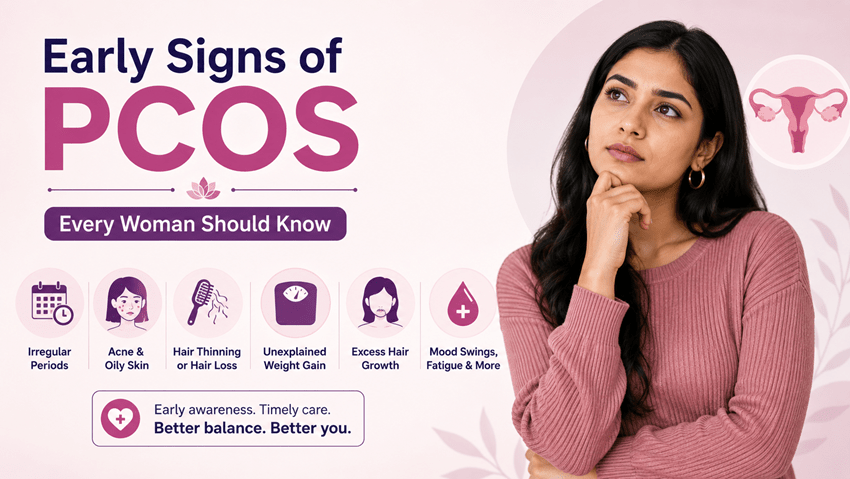
Early Signs of PCOS Every Woman Should Know. If your periods come and go whenever they like, your skin keeps breaking out no matter what you try and your weight won’t budge even though you eat carefully — you are not imagining things. These are among the earliest signs of Polycystic Ovary Syndrome (PCOS) and they deserve serious attention.
What Is PCOS? A Simple Explanation
Polycystic Ovary Syndrome, commonly called PCOS is a hormonal condition that affects women during their reproductive years (roughly ages 15 to 44). The name can be misleading — you don’t actually need to have “cysts” on your ovaries to have PCOS. What really happens is this: your ovaries produce slightly too much of a male hormone called androgen. This excess androgen interferes with your normal ovulation cycle, leading to a cascade of symptoms that affect your skin, weight, hair, mood and fertility.
PCOS is not a disease you “catch.” It is a hormonal imbalance — one that is very common, very manageable and absolutely not your fault.
How Common Is PCOS in India and Pune?
The numbers are striking. A landmark national study published in JAMA Network Open (2024), involving 9,824 Indian women aged 18 to 40, found that up to 19.6% of Indian women have PCOS when diagnosed using the Rotterdam criteria. Urban women in cities like Pune, Mumbai and Delhi show consistently higher rates than rural women — driven by sedentary IT jobs, processed food habits, irregular sleep and chronic stress.
In Pune’s booming IT corridors — Hinjewadi, Wakad, Baner and Kothrud — young working women between ages 18 and 35 are among the most affected. Long working hours, desk jobs, irregular eating schedules and high stress levels are all known risk factors.
10 Early Signs of PCOS Every Woman Should Know:
Most women don’t know they have PCOS until they try to get pregnant or have a blood test for something else. But your body often gives signals much earlier. Here are the ten most important early warning signs:
1. Irregular or Missed Periods:
This is the most common and often the earliest sign. A normal menstrual cycle runs between 21 and 35 days. With PCOS, many women have cycles longer than 35 days, skip periods entirely for months or have unpredictable, inconsistent cycles. Some women experience very heavy bleeding when they do get their period.
If you can’t predict when your next period will come, speak to a gynecologist — don’t just dismiss it as “stress.”
2. Unexplained Weight Gain (Especially Around the Belly):
About 70% of women with PCOS have some degree of insulin resistance — meaning their body doesn’t process glucose efficiently. This leads to weight gain, particularly around the abdomen, even when diet and exercise habits haven’t changed much. Many women in Pune report gaining 5–8 kg over a year without obvious cause, which is a red flag.
3. Acne Along the Jawline, Chin and Neck:
Hormonal acne that clusters around the lower face — jawline, chin and neck — and doesn’t respond well to standard skincare or antibiotics is a classic PCOS symptom. This happens because excess androgens stimulate oil glands in the skin.
4. Unusual Hair Growth on the Face or Body (Hirsutism):
Fine dark hair appearing on the upper lip, chin, chest, abdomen or inner thighs is called hirsutism. It affects roughly 60–70% of women with PCOS. This is directly caused by elevated male hormone (androgen) levels and is not a cosmetic problem — it is a medical symptom.
5. Hair Thinning or Loss on the Scalp:
While hair grows in unwanted places, it thins in the place you want it most — the scalp. PCOS-related hair loss typically follows a “male-pattern” distribution, thinning at the crown or along the top of the head. This is different from stress-related hair fall and requires hormonal evaluation.
6. Darkened Skin Patches (Acanthosis Nigricans):
Look at the back of your neck, your underarms. Dark, velvety patches of skin in these areas are called acanthosis nigricans and are a direct sign of insulin resistance — which is strongly linked to PCOS. Many women mistake this for a skin hygiene issue, but it is a hormonal marker.
7. Persistent Fatigue and Low Energy:
Despite sleeping 7–8 hours, many women with PCOS wake up feeling exhausted. Insulin resistance disrupts how your body produces and uses energy. If you feel chronically tired, sluggish or foggy — and nothing seems to help — it may be worth checking your hormonal health.
8. Mood Changes, Anxiety and Depression:
PCOS doesn’t just affect the body — it significantly affects mental health. Studies show women with PCOS are 2–3 times more likely to experience anxiety and depression than women without the condition. Hormonal fluctuations directly impact brain chemistry, including serotonin and dopamine levels.
9. Difficulty Getting Pregnant:
PCOS is the leading cause of an ovulatory infertility (infertility caused by a failure to ovulate) in women worldwide. If you have been trying to conceive for 6–12 months without success, PCOS should be ruled out or confirmed with a proper diagnostic workup.
10. Pelvic Pain or Bloating:
Some women with PCOS experience mild to moderate pelvic discomfort, particularly around ovulation time or during periods. Persistent bloating, especially in the lower abdomen, is another under-reported symptom worth discussing with your gynecologist.
When Should You See a Gynecologist in Pune for PCOS?
Most women don’t know they have PCOS until they try to get pregnant or have a blood test for something else. But your body often gives signals much earlier. Here are the ten most important early warning signs:
1. Irregular or Missed Periods:
This is the most common and often the earliest sign. A normal menstrual cycle runs between 21 and 35 days. With PCOS, many women have cycles longer than 35 days, skip periods entirely for months or have unpredictable, inconsistent cycles. Some women experience very heavy bleeding when they do get their period.
If you can’t predict when your next period will come, speak to a gynecologist — don’t just dismiss it as “stress.”
2. Unexplained Weight Gain (Especially Around the Belly):
About 70% of women with PCOS have some degree of insulin resistance — meaning their body doesn’t process glucose efficiently. This leads to weight gain, particularly around the abdomen, even when diet and exercise habits haven’t changed much. Many women in Pune report gaining 5–8 kg over a year without obvious cause, which is a red flag.
3. Acne Along the Jawline, Chin and Neck:
Hormonal acne that clusters around the lower face — jawline, chin and neck — and doesn’t respond well to standard skincare or antibiotics is a classic PCOS symptom. This happens because excess androgens stimulate oil glands in the skin.
4. Unusual Hair Growth on the Face or Body (Hirsutism):
Fine dark hair appearing on the upper lip, chin, chest, abdomen or inner thighs is called hirsutism. It affects roughly 60–70% of women with PCOS. This is directly caused by elevated male hormone (androgen) levels and is not a cosmetic problem — it is a medical symptom.
5. Hair Thinning or Loss on the Scalp:
While hair grows in unwanted places, it thins in the place you want it most — the scalp. PCOS-related hair loss typically follows a “male-pattern” distribution, thinning at the crown or along the top of the head. This is different from stress-related hair fall and requires hormonal evaluation.
6. Darkened Skin Patches (Acanthosis Nigricans):
Look at the back of your neck, your underarms. Dark, velvety patches of skin in these areas are called acanthosis nigricans and are a direct sign of insulin resistance — which is strongly linked to PCOS. Many women mistake this for a skin hygiene issue, but it is a hormonal marker.
7. Persistent Fatigue and Low Energy:
Despite sleeping 7–8 hours, many women with PCOS wake up feeling exhausted. Insulin resistance disrupts how your body produces and uses energy. If you feel chronically tired, sluggish or foggy — and nothing seems to help — it may be worth checking your hormonal health.
8. Mood Changes, Anxiety and Depression:
PCOS doesn’t just affect the body — it significantly affects mental health. Studies show women with PCOS are 2–3 times more likely to experience anxiety and depression than women without the condition. Hormonal fluctuations directly impact brain chemistry, including serotonin and dopamine levels.
9. Difficulty Getting Pregnant:
PCOS is the leading cause of an ovulatory infertility (infertility caused by a failure to ovulate) in women worldwide. If you have been trying to conceive for 6–12 months without success, PCOS should be ruled out or confirmed with a proper diagnostic workup.
10. Pelvic Pain or Bloating:
Some women with PCOS experience mild to moderate pelvic discomfort, particularly around ovulation time or during periods. Persistent bloating, especially in the lower abdomen, is another under-reported symptom worth discussing with your gynecologist.
When Should You See a Gynecologist in Pune for PCOS?
See a gynecologist as soon as possible if you notice any of the following:
- Your periods are irregular — more than 35 days apart or absent for more than 3 months
- You have unexplained weight gain, especially around the abdomen
- You notice dark, thick hair on your face, chest or abdomen
- You have persistent acne that doesn’t respond to treatment
- You’ve been trying to conceive for 6 months (if over 35) or 12 months (if under 35) without success
- You have a first-degree relative (mother or sister) with PCOS
Don’t wait. PCOS diagnosed at 22 is far easier to manage than PCOS discovered at 32 when you’re already facing fertility challenges, metabolic complications or mental health struggles.
Why Choose Goodfaith Healthcare for PCOS Treatment in Hinjewadi, Pune?
Dr. (Surg Cdr) Gargi Tripathi brings a rare combination of military precision and compassionate care to gynaecology. As a Gynecologist, High-Risk Pregnancy Specialist, and Infertility Expert based in Hinjewadi — one of Pune’s fastest-growing IT hubs — she understands the unique health challenges faced by working women in this region.
Why patients from Hinjewadi, Wakad, Baner, Aundh, and Pimpri-Chinchwad choose Goodfaith Healthcare:
- Comprehensive PCOS workup under one roof — consultation, ultrasound, blood tests and treatment planning
- Specialised care for fertility-related PCOS by an experienced infertility specialist
- High-risk pregnancy management for women who conceive with PCOS
- Transparent pricing with no hidden costs
- Flexible appointment timings suited to IT professionals
Conclusion:
An early diagnosis means simpler treatment, better outcomes and a healthier future.
Goodfaith Healthcare — Dr. (Surg Cdr) Gargi Tripathi Gynecologist, High-Risk Pregnancy Specialist Infertility Expert Hinjewadi, Pune.
PCOS Diagnosis & Management, Fertility Treatment & Ovulation Induction, High-Risk Pregnancy Care, Hormonal Health Consultations, Telemedicine Available
Book Your Appointment Today — Because your hormonal health matters and you deserve expert care from a specialist who understands women’s health inside and out.